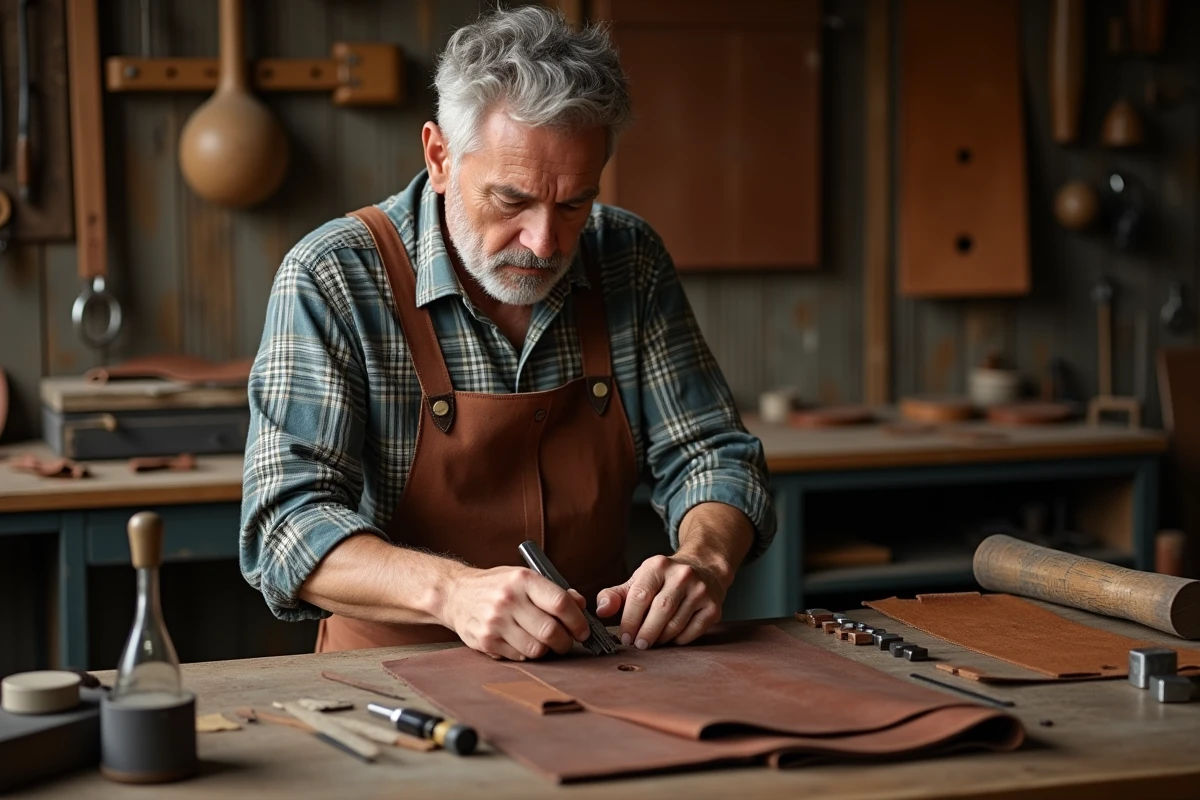
The choice of the punching tool determines the sharpness of the hole, the durability of the stitching, and the longevity of the finished piece. Punching leather is not just about penetrating a thickness of material: the type of tanning, the density of the fibers, and the desired diameter each impose a distinct approach.
Titanium Awls and Exotic Leathers: A Parameter Ignored by Classic Guides
On standard leathers (cowhide, goat), the hardened steel of common awls is sufficient. The situation changes with exotic leathers like ostrich, whose irregular fiber structure causes frequent tearing upon penetration.
Independent tests reported by the International Leather Association in April 2026 show that titanium awls significantly reduce tearing on ostrich leather compared to standard steel. Titanium combines rigidity, lightness, and a smoother surface finish that limits snagging in the disordered fibers.
We recommend titanium whenever you work with leather that has pronounced natural grain reliefs (ostrich, crocodile, lizard). On full-grain cowhide or goat leather, the investment is not justified. A detailed tutorial on leather punching on Zazie Web usefully complements this approach for intermediate profiles.
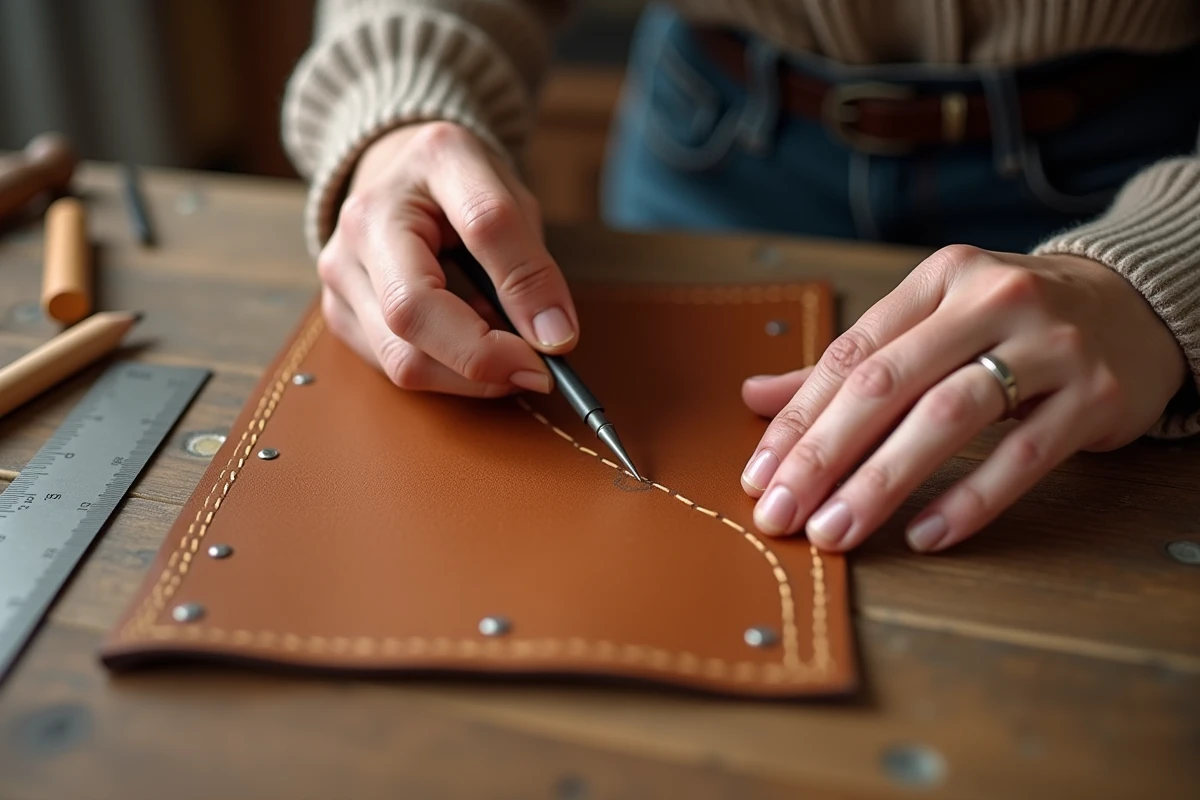
Premature Wear of Diamond Dies on Vegetable Tanned Leather: Adapting Consumables
Diamond dies, prized for their longevity on chrome-tanned leathers, pose an increasing problem on alkaline-treated vegetable leathers. Since mid-2025, professional artisans have noted a significant decrease in the lifespan of these dies on this type of tanning, as compiled in the Leathercraft Forum Annual Report 2025.
The explanation lies in surface chemistry. Alkaline vegetable tanning produces a more abrasive leather when cut, which attacks the diamond coating much faster than expected. On alkaline vegetable leather, prefer rechargeable steel punches rather than disposable diamond dies.
Three criteria guide the choice of consumable according to tanning:
- Chrome leather: diamond die or rotary punch, slow wear, spaced replacement
- Classic vegetable leather (neutral tannins): hardened steel awl or manual punch, good cost/durability compromise
- Alkaline vegetable leather: rechargeable steel punch, avoid diamond which dulls prematurely
Leather Punching and Hybrid 3D Printers: Creating Patterns in One Pass
The intersection of leather goods and additive manufacturing opens a technical field that is still poorly documented. Hybrid 3D printers, equipped with an interchangeable head (polymer extrusion and cutting/punching tool), allow for punching a complex pattern directly onto a piece of leather stretched on the bed.
The main constraint remains managing the variable thickness of the leather under the punching head. A full-grain cowhide can vary by several tenths of a millimeter on the same piece. Without a height sensor (like a Z probe), the penetration depth becomes random.
Critical Parameters for Successful Hybrid 3D Punching
Securing the leather on the bed determines the entire result. Poorly stretched leather warps under the tool’s pressure and produces oblong holes instead of round ones. We observe that vacuum beds yield better results than mechanical clamp frames.
- Head descent speed: too fast, the leather compresses before being punched, creating a bulge; too slow, the fibers stretch
- Tool diameter: beyond 3 mm, the leather’s resistance requires a two-step process (pre-punching then widening)
- Lubrication: a micro-drop of beeswax on the tip reduces heating and improves edge sharpness
- Pattern file: export in vector format with tight positioning tolerances, as leather does not forgive misalignment
This technique allows for reproducing decorative or functional patterns (punching for lacing, ventilation, embroidery) with a regularity that is impossible to achieve manually. However, it remains limited to leathers of moderate thickness.
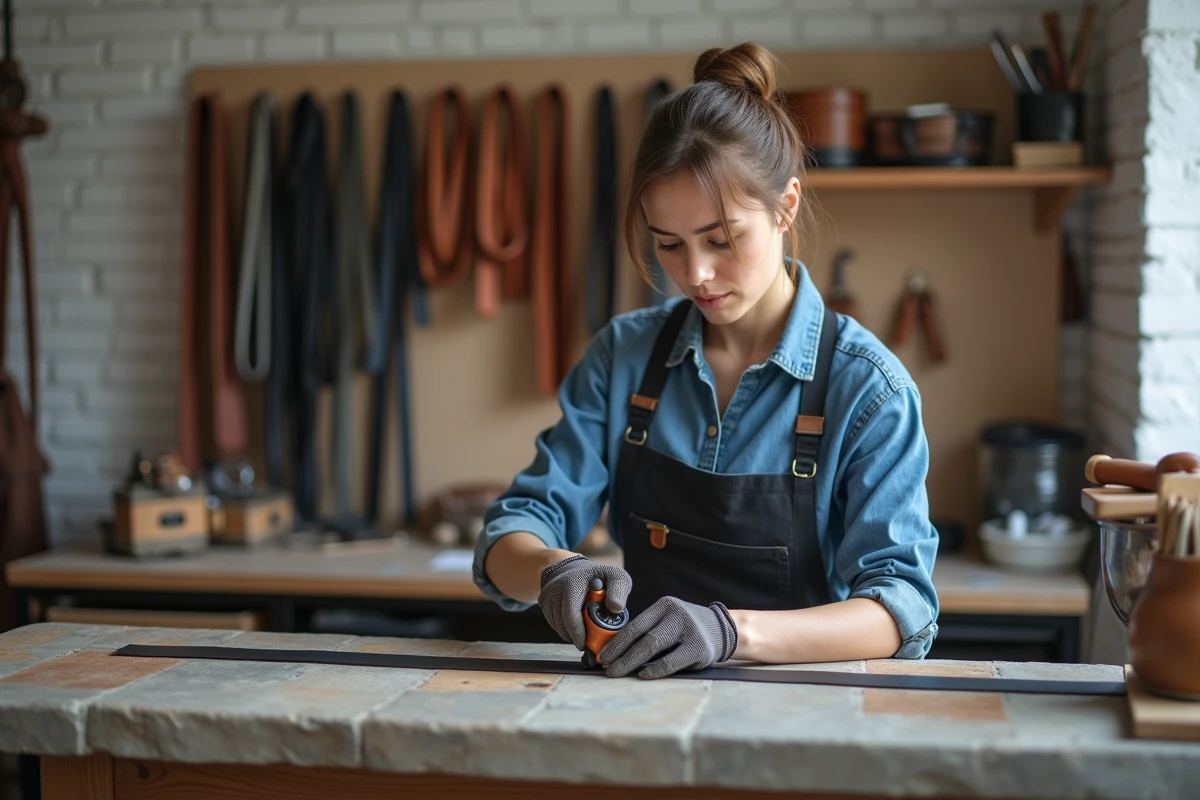
Rotary Punch or Striking Punch: Choose According to Leather and Technique
The rotary punch (Screw Punch type) is suitable for silent and controlled perforations on thin to medium leathers. Its screw mechanism applies progressive pressure that penetrates the leather without shock. The Screw Punch excels on soft leathers under 2 mm, particularly for light saddlery and small leather goods.
The striking punch, paired with a nylon or wooden mallet, remains the reference for thick or multi-layered leathers. The dry strike produces a clean hole as long as you work on an appropriate cutting block (high-density polyethylene or end grain wood).
Cutting Support and Hole Quality
A detail often overlooked: the support under the leather determines as much the cleanliness of the hole as the tool itself. A block that is too hard (marble, metal) crushes the fibers upon exit and creates burrs on the flesh side. A block that is too soft absorbs the striking energy and leaves an incomplete hole.
High-density polyethylene offers the best compromise between firmness and absorption. It partially regenerates after each impact, which also extends the lifespan of the punch.
Regardless of the tool chosen, technique is as important as the material. A perfectly sharpened punch in an uncertain hand produces a result inferior to an average tool handled with confidence and verticality. Working on a sample of the same leather before tackling the final piece remains the most cost-effective and often forgotten precaution.