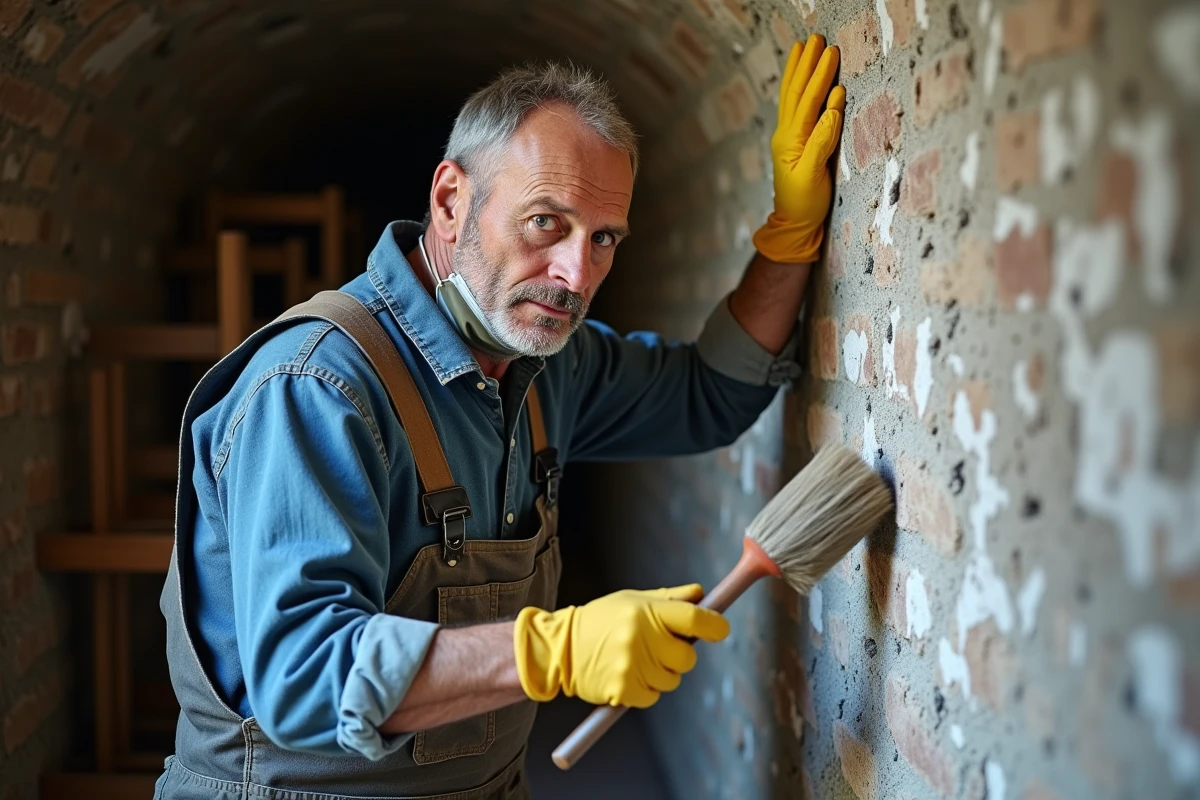
When scratching the whitish deposits at the bottom of a basement wall and they return in a few weeks, the problem is not on the surface. Saltpeter, this crystallized potassium nitrate, indicates active water migration through the masonry.
Treating saltpeter in a damp basement without addressing the source of this water is like repainting over a leak. We take stock of the methods that actually work, from diagnosis to foundational treatments.
Humidity Diagnosis in Basements: Locating Water Before Touching the Wall
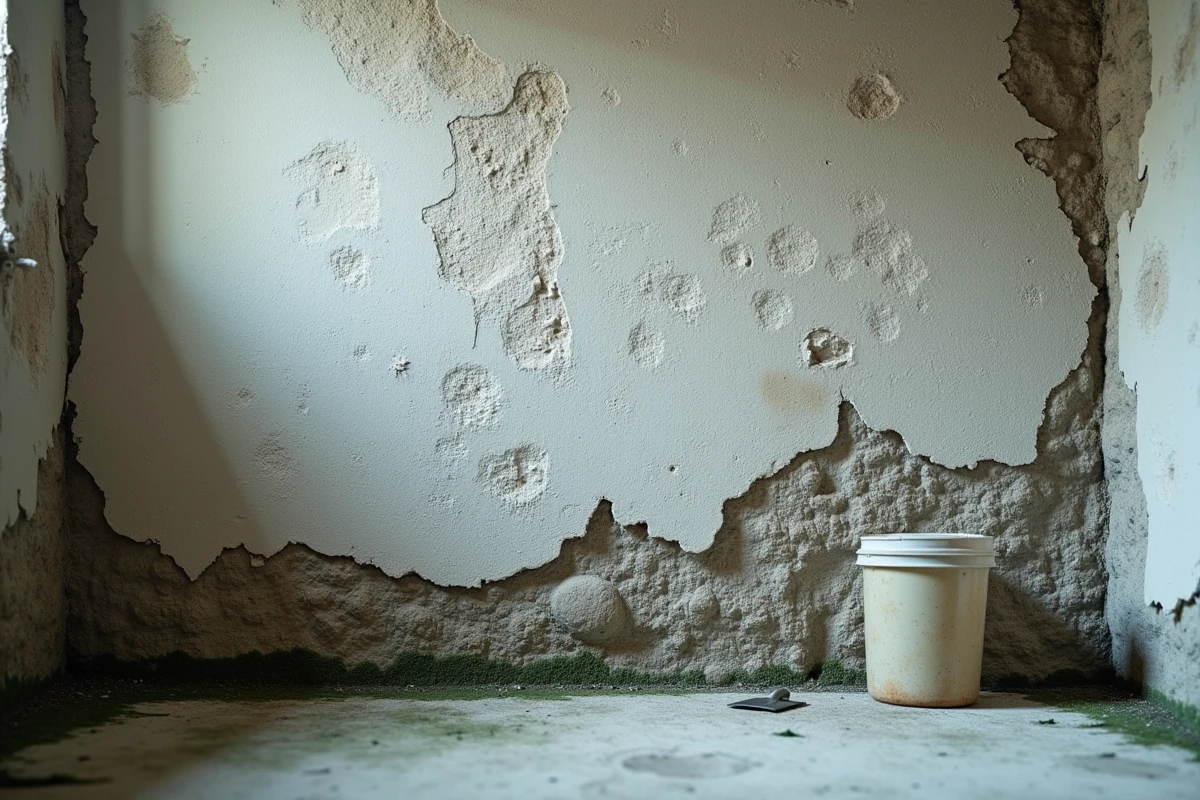
Before buying any products, we start by observing the distribution of stains. Saltpeter concentrated at the bottom of the walls (up to about one meter high) points to rising damp. Deposits higher up, often accompanied by dark halos, suggest lateral infiltration related to a defect in external waterproofing or a leak.
This distinction changes everything for what comes next. You do not treat rising damp with a simple surface cleaning or a waterproof paint. If you confuse saltpeter with mold, you apply a fungicide where a mineral treatment is needed, and vice versa.
To confirm the diagnosis, you can stick a square of plastic film on the wall for a few days. If condensation appears on the wall side, the water comes from inside the wall. If it appears on the basement side, it is a problem of ambient humidity.
This rudimentary test already points towards the right family of solutions. When you engage in treating saltpeter in a basement, this prior diagnosis saves time and money.
Cleaning Saltpeter from Basement Walls: The Right Sequence of Work
Once the cause is identified, we tackle the existing deposits. Cleaning saltpeter without a method damages the substrate and makes subsequent treatments less effective.
Preparing the Substrate
We dry brush with a metal brush or a wire brush to remove the layer of crystals. Working on a dry wall (or as dry as possible) prevents dissolving the salts and pushing them deeper into the masonry. Then, we carefully vacuum the residues.
Neutralizing the Salts
After brushing, we apply an anti-saltpeter product suitable for the type of substrate (stone, concrete block, brick). Acid-based solutions (white vinegar, diluted citric acid) work on light deposits, but do not treat the migration of salts deep down.
For a wall loaded with nitrates, a specific mineral treatment penetrates more deeply and blocks surface crystallization.
We let it dry completely before any finishing. Applying a coating or paint on a still damp wall traps the water and restarts the cycle. Feedback varies on drying times, but counting several weeks in a poorly ventilated basement remains prudent.
Rising Damp and Resin Injection: When Cleaning is No Longer Enough
If saltpeter reappears despite careful cleaning, it means that water continues to rise by capillarity from the ground. We are then in a foundational treatment, not a surface one.
Injecting waterproofing resin at the base of the walls is the most common solution to cut off rising damp. The principle: we drill a line of holes at the base of the wall, spaced regularly, and then inject a hydrophobic resin that creates a waterproof barrier in the masonry.
This treatment requires a clean substrate and precise implementation conditions. A few points to check before getting started:
- The thickness of the wall determines the number of rows of drilling and the type of resin (gel, liquid). A thick stone wall may sometimes require injection from both sides.
- The moisture content of the wall at the time of injection influences the setting of the resin. Some products can be applied to a damp wall, while others require pre-drying.
- The nature of the external soil also plays a role: clayey ground retains water against the foundations and may require additional drainage for the injection to last over time.
We are talking about work that affects the structure. Involving a waterproofing professional for diagnosis and injection remains the most reliable approach when rising damp is confirmed.
Damp Basement Ventilation: The Often-Underestimated Lever
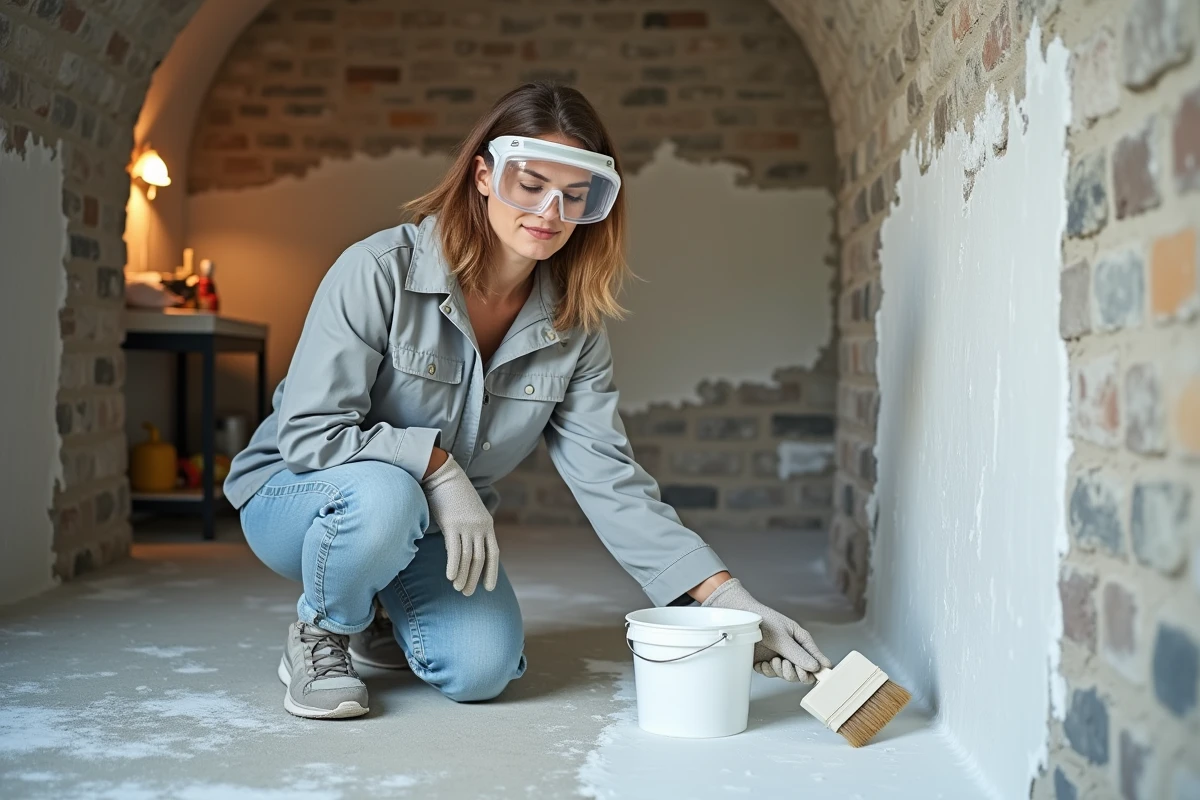
We can treat the walls, inject resin, apply a waterproofing coating, and see the saltpeter return if the air in the basement stagnates. Air renewal is a treatment in its own right, not just a simple complement.
An underground basement without openings accumulates moisture produced by the natural evaporation of the soil and walls. Without circulation, the humidity level remains permanently high, which promotes the crystallization of salts on the surface.
Ventilation Solutions Suitable for Basements
When the basement has at least one opening, mechanical ventilation by insufflation (VMI) or a simple extractor fan is sometimes enough to lower the humidity level. For completely underground basements, a controlled mechanical ventilation system dedicated to the basement remains the most effective solution.
Care should be taken not to create a cold draft in winter on already fragile walls, which would cause additional condensation. The goal is regular and moderate renewal, not a sudden drying out.
Finishing and Long-Lasting Protection of Basement Walls After Treatment
Once the source of humidity is treated and the wall cleaned, we protect the surface to prevent the return of saltpeter. The choice of finish depends on the level of residual humidity.
- For a dry wall after treatment of rising damp, a lime plaster (breathable) allows the wall to continue regulating residual humidity without trapping salts.
- For a wall still slightly damp, a waterproofing coating forms a barrier on the interior side. This type of coating withstands water pressure and is suitable for underground basements.
- Water-repellent surface paints work as a complement, never alone. Applied to an untreated wall, they will blister in a few months.
The preparation of the substrate determines the lifespan of any finish. A coating applied over salt residues or a poorly dried wall degrades quickly. We spend as much time preparing as applying.
Saltpeter in a basement only disappears permanently by treating the entire chain: diagnosing the source of the water, appropriate cleaning, foundational treatment against rising damp if necessary, proper ventilation, and then breathable finishing. Skipping a step guarantees a return of the white crystals in the months that follow.