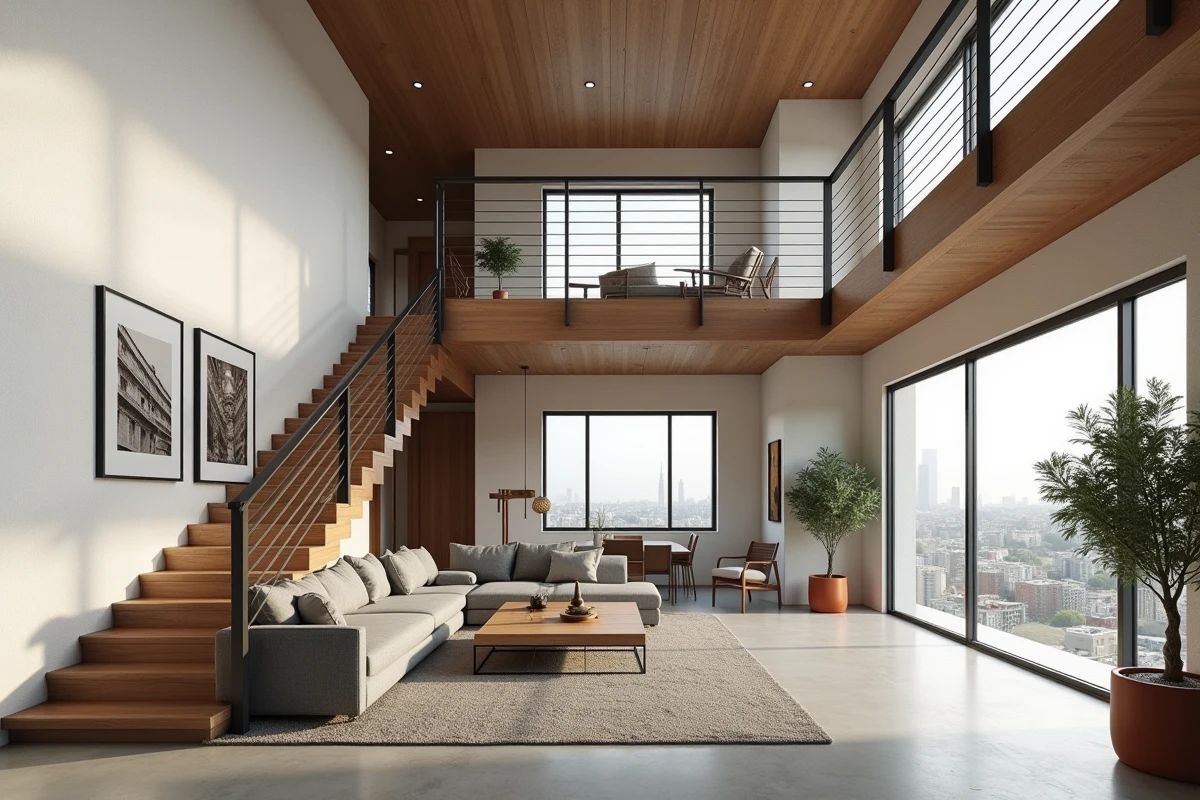
A duplex is not just two levels connected by a staircase. The vertical distribution of spaces profoundly alters the thermal dynamics, acoustics, and regulatory compliance of the unit. Before focusing on marketing advantages, we recommend understanding the technical constraints specific to this type of property.
Interior staircase of the duplex: technical and regulatory constraints
The interior staircase is the nerve center of a duplex. In a co-ownership, it is considered a private part, which means that its maintenance, compliance, and potential replacement are the sole responsibility of the unit owner.
Its geometry determines the declared living area. According to the Carrez law, the footprint of the staircase is excluded from the calculation of the private area. In a compact duplex, this footprint can represent a significant portion of the total area. A standard straight staircase takes up more floor space than a quarter-turn staircase but offers a more comfortable passage.
We observe that many buyers overlook the issue of the well. A well that is too narrow complicates the movement of bulky furniture and limits future remodeling options. Conversely, an oversized well reduces the usable area of the upper floor. To know precisely what a duplex apartment is in regulatory terms, it must be verified that the ceiling height of each level reaches at least 1.80 m on the declared surface.
PMR accessibility standards do not apply inside an existing private unit, but they impact resale: a duplex without the possibility of accommodating a sleeping area at the entrance level effectively excludes part of the potential buyers.

Thermal and acoustic insulation between levels of a duplex
The vertical separation creates an intermediate floor that is not a separating floor between two units. In practice, there is no obligation for sound insulation between the two levels of the same duplex. Impact noise (footsteps, falling objects) propagates freely from one floor to another if the floor is made of wood or metal without decoupling.
Thermally, the distribution over two levels generates a stratification effect: warm air naturally rises to the upper floor. Duplexes located on the top floor combine this phenomenon with heat loss through the roof. We recommend systematically checking the DPE, which includes these losses, and inspecting the insulation of the upper floor or terrace roof if applicable.
Points of vigilance during a technical visit
- Check the nature of the intermediate floor: concrete, wood, steel. A wooden floor without a floating screed transmits almost all impact noise.
- Control the ventilation of each level. A duplex with a single VMC on the lower level and converted attics above often suffers from insufficient air renewal on the upper floor.
- Identify the passage of networks (water, electricity, drainage) between the two levels. Moving a bathroom to the upper floor involves plumbing work through the floor, subject to the co-ownership’s agreement if the floor is a common part.
Valuation and resale of a duplex apartment in co-ownership
Duplexes generally negotiate above the average price per square meter of standard apartments of the same size in a given building. This premium is explained by the rarity of the offer and the perception of comfort similar to that of a house.
Since the post-Covid period, the demand for atypical and adaptable properties has increased in dense urban centers. Remote work has heightened the need for a physical separation between living space and workspace, which the two-level distribution naturally allows.
Top-floor duplex: a distinct segment
Duplexes located on the top floors, often resulting from the combination of an apartment and converted attics, constitute a distinct segment. They frequently offer volumes under the roof with exposed beams, terraces, or unobstructed views. This high-end positioning attracts a wealthier clientele seeking a resilient asset, with a seasonal rental potential higher than that of a standard apartment.
On the other hand, reselling a duplex on the ground floor with a garden level remains more challenging. The configuration attracts families but deters rental investors, who prefer properties that are easier to manage.

Interior layout of a duplex: technical trade-offs
The layout of a duplex imposes choices that are not encountered in a single-level apartment. The classic distribution (living spaces below, bedrooms above) is not always the most relevant.
Placing the kitchen on the upper level, for example, brings the drainage networks closer to the main column in certain building configurations and frees up the lower level for a large, cross-through living room. Each redistribution project must be validated by a diagnosis of the existing networks before any work commitment.
- Prioritize natural lighting on each level. A duplex with one exposed level and the other blind loses a significant part of its appeal.
- Anticipate furniture: narrow or winding staircases prevent the passage of sofas, box springs, or countertops in one piece. This point, often discovered after moving in, may require custom furniture.
- Plan for a water point on each level if the configuration allows. A toilet at the entrance level is a comfort criterion that impacts resale value.
The duplex remains a unique real estate product, whose value depends as much on the quality of its technical design as on its location. A savvy buyer will focus their analysis on the intermediate floor, networks, and staircase before paying attention to the finishes. This is where the difference between a well-designed duplex and a simple apartment divided over two levels lies.