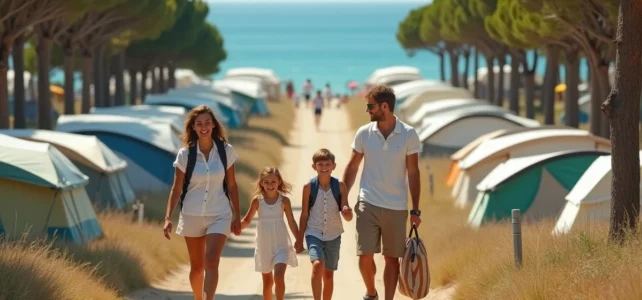
The title of the largest campsite in Europe frequently appears in summer searches, but the results often mix size, quality, and popularity. The campsite claiming this distinction is located on the Costa Brava, in Spanish Catalonia, near the village of Sant Pere Pescador. Understanding exactly where it is and how to access it requires untangling some common confusions about what “large” means in the camping sector.
Size of a campsite in Europe: what rankings really measure
The notion of “largest campsite” is not subject to any official standard shared by all European countries. Some rankings count the number of pitches, others the total area, and still others the capacity in terms of people. These criteria do not always refer to the same establishment.
The campsite often cited as the largest on the continent is Aquarius, located in the coastal plain of Empordà. Its size is based on a very high number of pitches and a land area that far exceeds that of large French or Italian campsites. In France, establishments in the Landes region like Le Vieux Port in Messanges rank among the largest in the country, but still fall short in terms of gross capacity.
To place the largest campsite in Europe and its ranking in a reliable perspective, it is important to keep in mind that data varies by source and reference year. Ground reports differ on this point, particularly because some campsites expand their mobile home areas without changing their declaration of bare pitches.

Sant Pere Pescador and the Costa Brava: location and road access
The Aquarius campsite is located between Barcelona and the French border, on the Mediterranean coast of Catalonia. The village of Sant Pere Pescador is situated in the Aiguamolls de l’Empordà Natural Park, a protected wetland area that directly borders the coastline.
From Barcelona, the route takes the AP-7 motorway towards Figueres, then secondary roads to the coast. The journey takes about an hour and a half under normal traffic conditions. From the French border at Perthus, expect about forty minutes south.
Access from Girona and Catalan airports
The nearest airport is Girona-Costa Brava, located less than an hour’s drive away. Barcelona-El Prat Airport remains an option for international flights, with a longer travel time. No railway line directly serves Sant Pere Pescador: the nearest train station is Figueres, from where you must then reach the campsite by road.
For travelers in motorhomes, the AP-7 is the backbone of the journey. Tolls have been removed on part of this route in Catalonia, simplifying the budget. However, summer traffic in the last kilometers before the coast can significantly slow down arrival, especially on Saturdays.
Reaching the campsite in a motorhome: constraints to anticipate
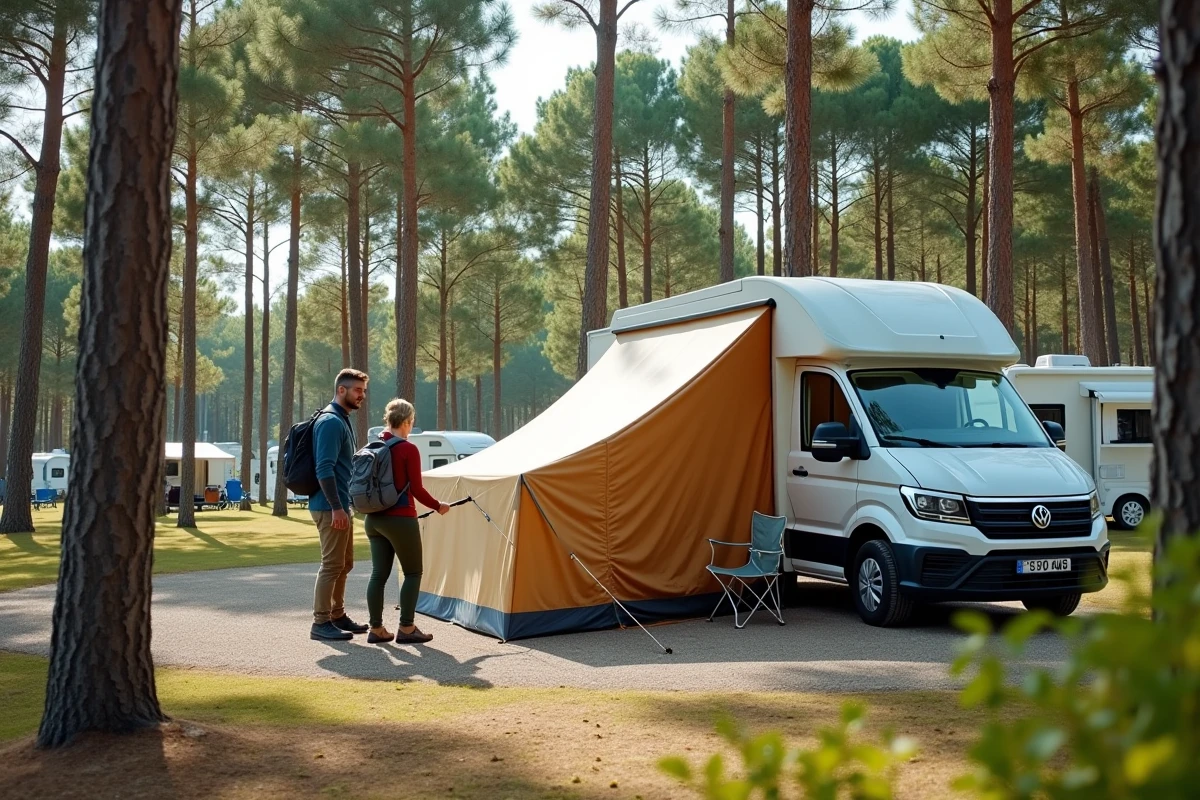
Traveling in a motorhome to southern Europe involves some checks that general camping guides often overlook in favor of lists of destinations.
- Updating the GPS is a concrete prerequisite: Catalan secondary roads regularly change traffic directions during the summer, and some coastal accesses are prohibited for vehicles over 3.5 tons.
- Local parking rules in Spain differ from those in France. Wild parking by the beach is penalized in the Aiguamolls Natural Park area, with fines imposed by local police.
- Vehicle documents must include the green insurance card, even though it is no longer technically mandatory in the EU, as Spanish road checks still frequently request it.
- Passing through the toll at Perthus on the French side remains charged. Having coins or a compatible electronic toll badge for the Spanish network (Via-T) facilitates crossing.
Giant campsite and natural environment: a tense coexistence
The establishment of a campsite of this scale on the edge of a protected natural park raises questions that promotional brochures do not address. The Aiguamolls de l’Empordà park is home to migratory bird species whose nesting is directly affected by summer tourist traffic.
The available data does not allow for a precise conclusion about the impact of the Aquarius campsite compared to other establishments in the area. Several medium-sized campsites line the same coastline, and the cumulative pressure exceeds that of a single site. Catalan authorities have tightened access restrictions to certain beaches during the breeding season, which may temporarily limit camper traffic.
Water management and occupancy density
A campsite hosting several thousand people simultaneously consumes considerable volumes of water. In a Mediterranean region subject to recurring drought episodes, the issue of water supply remains a subject of local tension. Catalonia has experienced usage restrictions in recent years that have affected campsites, including temporary bans on filling swimming pools.
This water constraint does not only concern the largest campsite, but it weighs proportionally more on high-capacity establishments. Campers planning a stay during the high season should check for any restrictions in place at the time of their booking.
Denmark, France, Italy: other giants of European camping
The title of largest campsite is contested based on the criteria used. Denmark has several holiday parks whose area rivals that of Mediterranean campsites, particularly on the west coast of Jutland. These establishments combine camping pitches, cottages, and recreational facilities over very large areas.
In France, campsites in the Landes and Médoc regions often have capacities exceeding a thousand pitches. In Italy, the Adriatic coast around Cavallino-Treporti concentrates campsite-villages with some of the highest accommodation densities on the continent.
Comparison remains difficult because each country applies its own administrative categories. A Danish “camping” includes facilities that a French campsite would classify as a tourist residence. The classification thus depends as much on national regulations as on the actual size of the site.
For a traveler primarily seeking space and proximity to nature, the gross size of a campsite guarantees nothing. An establishment with several thousand places may offer spacious pitches or, conversely, cram mobile homes into every available square meter. The only way to decide is to consult the site plans before booking, when campsites agree to publish them.